
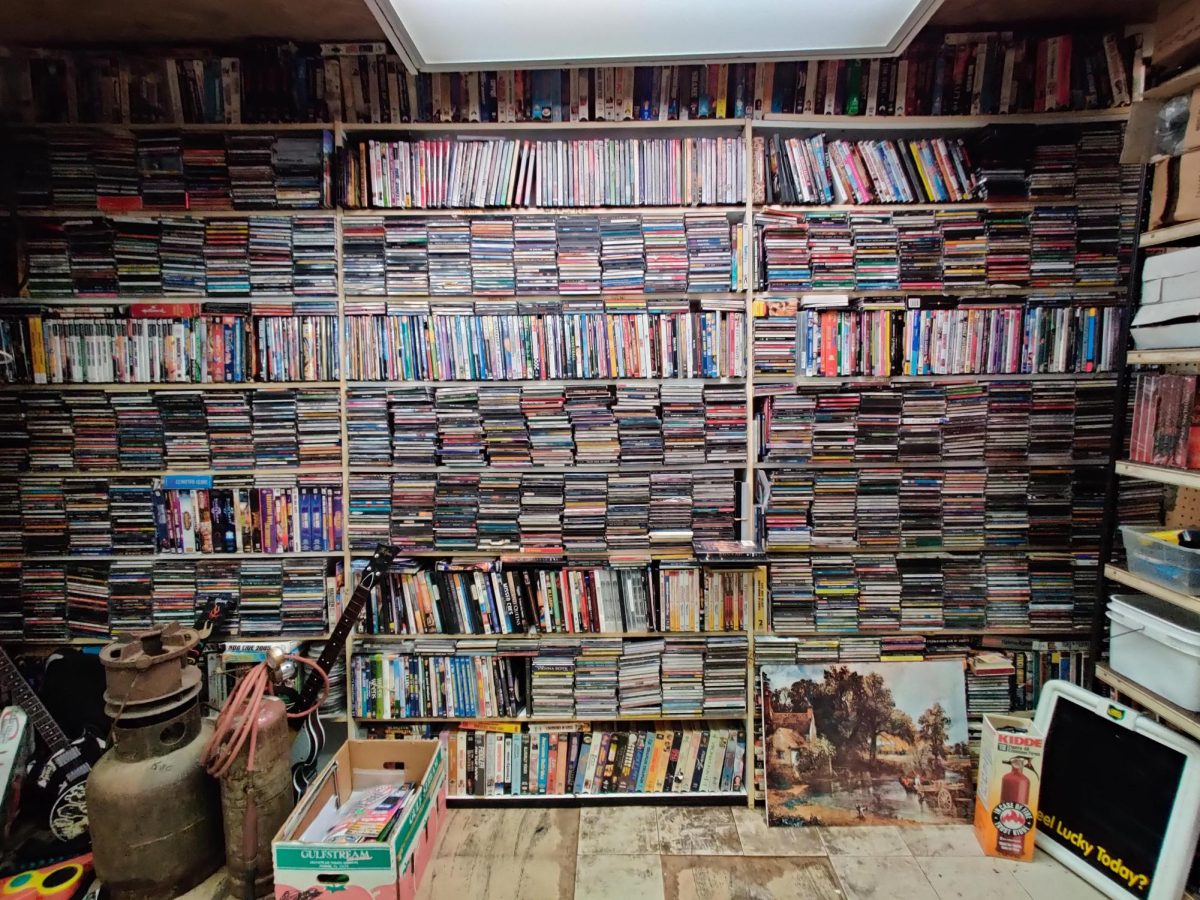
The desire for physical media is not dead. There is a growing demand, especially among Gen Z, for the return of things like newspapers, DVDs, CDs and vinyl records.
I was cleaning my room the other day and found a DVD copy of the anime film Akira, a masterpiece from the 1980s that inspired my personal journey into art and drawing. I also found all six volumes of the manga as well — the books are huge and full of beautiful art.
It felt nice to just hold them, flip through the pages and relive memories. I feel almost a sense of pride in my collection.
I felt the same with my CD collection, which I unfortunately lost during moves. These collections are tangible, and I’m starting to miss things that are tangible.
My appreciation for physical media is relatively new. Like most people around my age, I pushed the memories of it to the back of my mind.
I had the assumption that physical media like DVDs, CDs and print media were dead now and won’t be able to come back. This made digital life easy to embrace.
I’ve been on the internet since I was about 6 years old, for better or for worse. Being online since a young age has done both good and bad for me. My main form of socialization and entertainment has been the internet for much of my life, or two decades now.
For me, this also had the side effect of becoming dependent on the internet for news consumption.
Growing up, physical newspapers were always around. But they were always boring, so my attention only centered around the comic section.
Though the appeal of print media was lost on me, I did watch the news on television, and it is eventually what led to my passion for the news today.
News on the TV and the internet is great, but flawed, too. Personally, I feel that news on digital media is much more prone to misinformation and inaccuracy, because of how fast it’s produced.
Information spreads faster digitally than it would through print media, and this is a double edged sword.
This isn’t to suggest print media isn’t capable of spreading misinformation. But because of how much time and effort needs to be spent on the crafting of a newspaper, it makes it so the writers have to be more careful with what they choose to publish.
Print media is a craft; it’s an art form that requires patience and attention to detail.
As mentioned earlier, I love art and enjoy making art as well. I switched to mostly digital art when I was around 13 years old and spent a long time only doing digital work instead of drawing in sketchbooks.
Most of the artists I follow are the same: We all pivoted to digital and forgot how fun it is to just draw on paper.
With digital art, I became way more of a perfectionist because it’s so easy to edit and tweak my art to make it exactly how I want it. However, when you draw on paper, it forces you to confront mistakes as they happen.
Sometimes when I draw on paper now, my finger instinctively goes to an undo button that is not there. Mistakes can and will happen in traditional art, and when they do, there is no magic button to fix it. You have to adapt and find a way to work with that mistake.
It’s challenging, but rewarding. I’ve been making an effort to create more traditional art now, including drawing once a day in a sketchbook. Setting aside time to engage with a physical craft has become something to look forward to now.
One of the first steps of addiction treatment is acknowledging the problem.
When told that we might have a phone addiction, a lot of us roll our eyes and immediately deny. For instance, my addiction to my phone and social media wasn’t apparent to me, until this month.
So much time is wasted scrolling and not even reading anymore. The scrolling never stops; hoping for a dopamine hit that often doesn’t come, even after hours on the phone.
I finally realized that I have to be the one to make a change. It doesn’t make sense for me to mourn the alleged death of physical and print media and then do nothing to engage with it anymore.
We can do something about this, and it starts by disconnecting.
Put down the phone, and step away from the computer. Pick up a book or a newspaper — perhaps it’s this one. There is a beauty in the simple routine of grabbing something physical to read while you have your coffee or drink of choice.
This isn’t to say we have to abandon our technology entirely. Even when I’m drawing in my sketchbook, I will have references pulled up on my screen with music playing at the same time.
The goal is to reduce the scrolling. We still very much need our devices, but I just feel that we need to be using them a lot more wisely than we do now.
Try reading more articles instead of short-form social media posts. We’re facing a literacy crisis, and it seems a lot of that has to do with social media itself.
Consider that there are not enough writing focused platforms. Besides Substack, which I joined recently, what other options exist?
We need to do something about the brain rot crisis too, because tech companies are not going to save us. We have to be the ones to take back our autonomy.
There are ways to enjoy both digital and physical media, which means we don’t have to stick to just one or the other. The key here is finding balance.
We should let our nostalgia lead us to ways we can engage with what we miss so much. We don’t have to let physical and print media die, and we can even use digital media to bring awareness to the physical.
We have the power to breathe life into things that have been abandoned. So the next time you walk by a copy of The Globe, pick it up and read it.
Read, and touch more paper instead of your phone.

