


Mike Day, Dean Fisher and Kevin Kauffman were visibly awestruck on their return to Point Park for the first time since graduating in 2009.
To them, the size of the Playhouse reaches a scale that they did not think was possible for the school. When they went to Point Park, the GRW was the only theater, they said, and they “never had anything like” the Playhouse.
Day, Fisher and Kauffman had a personal homecoming at the behest of Andrew Halasz, chair of the cinema department, for a screening of their recent feature film “Fog of War.” They hosted a discussion panel alongside the screening as part of this past weekend’s Steel City High School Film Festival, where they discussed how, like Point Park’s campus, the film industry is constantly changing.
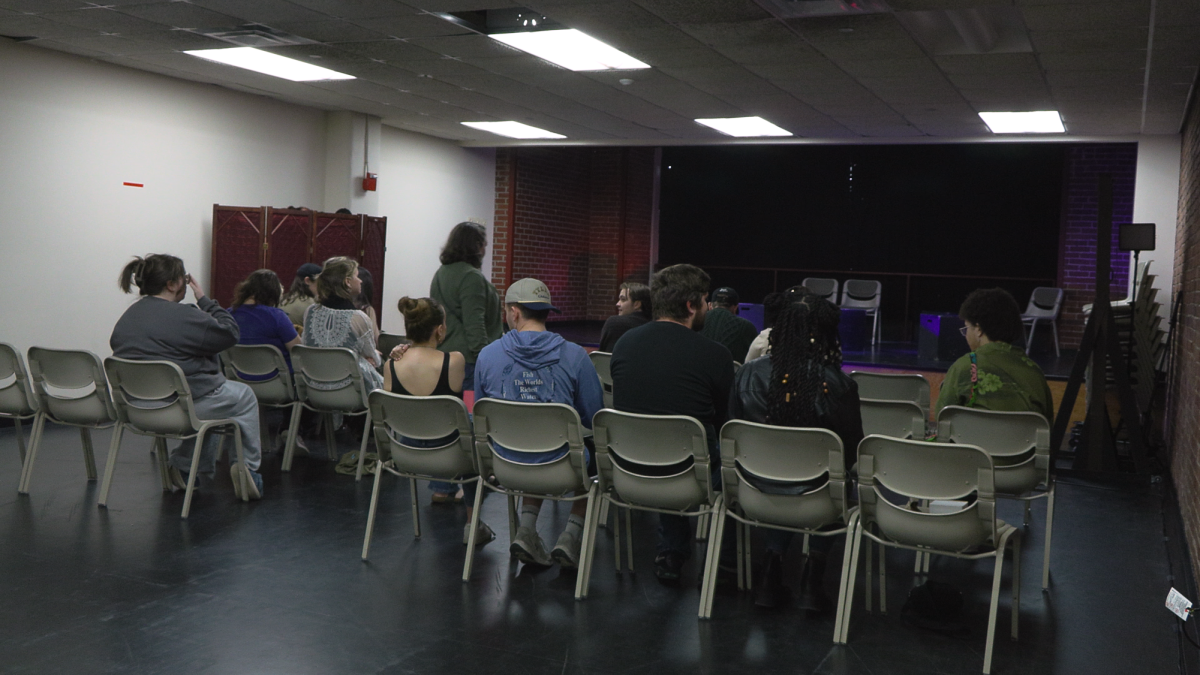
The panel drew a modest turnout of around 40 people, including Point Park students along with high school students from CAPA, Lincoln Park and Westinghouse Performing Arts.
The aim of both the screening and discussion panel, Halasz said, was to help students get in touch with both Point Park alumni and possibilities for a future career in film.
“[A] big part of the industry is knowing people,” Halasz said. “And knowing people who are more successful than you and learning the paths they took.”
Day, Fisher and Kauffman are no strangers to success: they’ve been working in movies non-stop since graduating. Prior to “Fog of War,” the trio worked together on 2023’s “Clawfoot,” a home invasion thriller.
Both of the movies were filmed quickly on tight budgets, with “Clawfoot” wrapping within a few days of its first shoot and “Fog of War” finishing its filming in 15 days. For Day, the film’s director, this production process brings back memories of working on films as a Point Park student.
“We’re always just trying to get more time,” Day said, “more days, more money — anything just to try to get the shot, too. But . . . it was a fun and wild ride, and I’m really proud of what we pulled off in that short amount of time.”
“Fog of War” is another thriller, this time based in World War II-era Massachusetts. It follows a soldier, Gene, played by Jake Abel, who struggles with paranoid thoughts of espionage while staying with his fiancé’s family.
Many made note of John Cusack’s presence in the film, as well. Though it was limited, Cusack plays an essential role in the film by its conclusion.
Fisher, the film’s cinematographer, said shooting for “Fog of War” was his first time working on a feature film.
“It was a learning experience for sure,” Fisher said. “It’s my favorite thing I’ve shot visually; I’m proud of it.”
He and Kauffman, the film’s editor, got a call from Day after the director was offered the script. They all continue to work together, Kauffman said, because of familiarity from their time at Point Park.
“You want to work with people that you really like, because film making is a lot of hours and a lot of stress and a lot of intense work,” Kauffman said. “So, if you’re with people that you like, and that you trust, it makes all the difference.”
Production was far from a steady road, though, and was gummed up by many factors outside of the crew’s control. Filming for “Fog of War” wrapped in May 2023. The months-long SAG-AFTRA strike would begin two months later, in July.
Because of that, Day, Fisher and Kauffman said they had to entirely halt production of the film until the strike ended in November of that year. The continuing evolution of AI-technology, which sparked the strike, is still a developing issue.
The trio each said Point Park cinema students should be aware of the struggles sometimes-guaranteed in both film production and the film industry.
“As long as you love it, then it’s worth it,” Day said. “And you have to be willing to just put it all in and also just be happy with [wherever you end up].”
Fisher echoed that sentiment, and said despite the “cut throat” nature of the film industry, those that succeed within it usually wouldn’t be happy doing anything else.
“You just need to listen to that voice inside,” Fisher said. “Like, what is it [you] really want to do? I know the industry is changing in ways, but for many years, I think there’s always going to be a need for what we do.”
Kauffman said a good life in film takes incentive, but that he still believes it is possible.
“If you really have the drive to do it, you have the will and the love, then you’ll do it and it will work,” Kauffman said. “And you need to create good connections; you need to learn and become good at what you do.”