

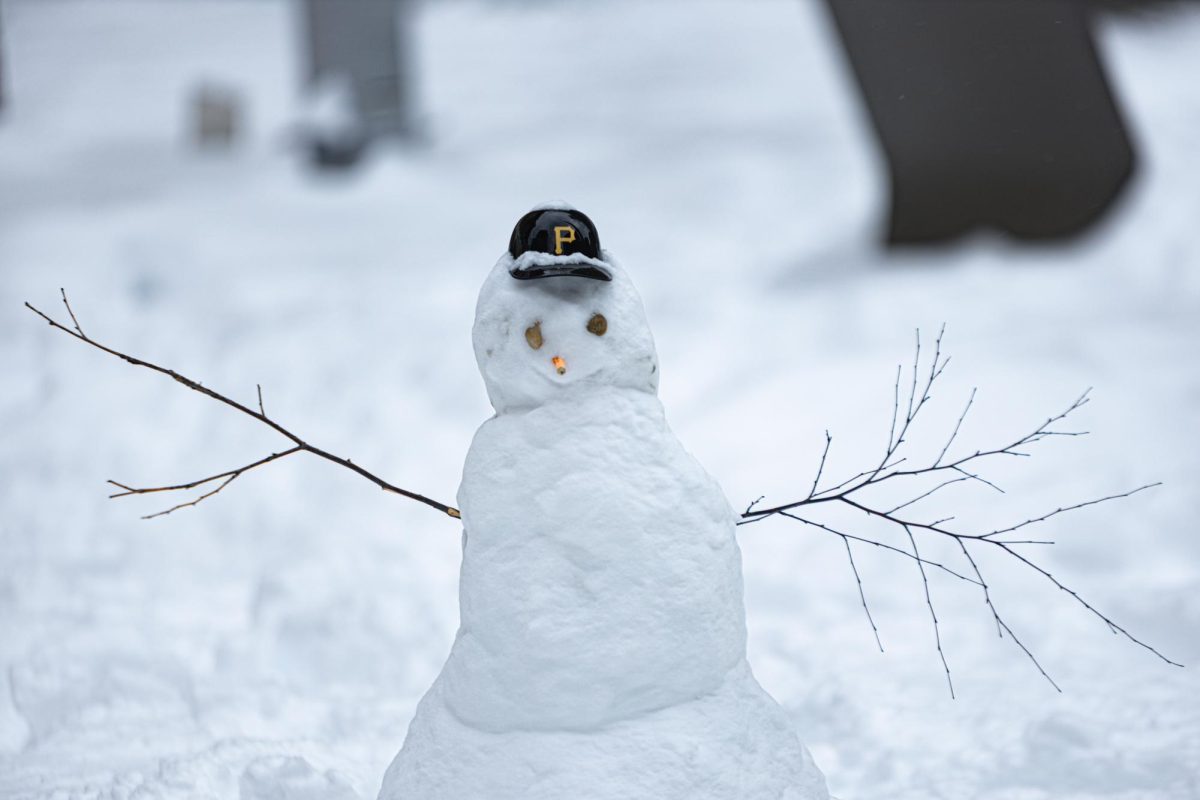
After last weekend’s snowfall missed the nearly 16 year standing record of 11.4 inches of snow by only 0.2 inches, according to WESA, Pittsburgh mayor Corey O’Connor declared a state of emergency.
The declaration, O’Connor said, was aimed at unlocking funding to hire privately contracted help for the city’s quickly-dwindling fleet of snowplows. As of reporting on Monday night, Pittsburgh is down to two-thirds of its starting snowplow fleet, with 37 of its 95 total trucks out of commission.
Allegheny County Executive Sara Innamorato, too, declared a state of emergency in Allegheny County, with a similar goal of streamlining emergency response, she said in a statement.
Despite the emergency declarations, Keith Paylo, vice president of student affairs, announced Monday night that classes would resume normal operations Tuesday.
“We just went through our normal process and procedures — in a sense of evaluating everything — and the determination was made to go back to normal operating hours for [Tuesday],” Paylo said in a phone call with The Globe after the announcement.
Paylo added that the decision was made with consideration of commuter students driving and bussing onto campus.
As of reporting, it is unclear if classes will also be held in-person on Wednesday.
Prior to the university’s announcement, most municipal agencies had shifted to essential-only functions. Paylo said officials considered this but still made the call to return in-person.
He hailed both Mayor O’Connor and Physical Plant’s response to the snow storm.
O’Connor delivered regular statements via social media to update Pittsburghers on Public Works’ progress clearing snow, and a new official city website offers live locations and past routes of every working snowplow in the city.
“I heard him calling in outside contractors and everything to help clean up the snow,” Paylo said, “which I think is admirable. I don’t know if I’ve seen that in the past.”


Physical Plant had cleared sidewalk paths by the early afternoon of Sunday, the day the snow hit.
“This isn’t company speak at all — because I’ve been here 23 years — I can’t say enough about our operations and housekeeping staff,” Paylo said. “Our sidewalks are always the best in the city, and I’ll always say that I think they do a fantastic job.”
By late Monday afternoon, most major roads through Downtown, like Boulevard of the Allies, Liberty Avenue and Grant Street, were clear. But cars could still be seen spinning out on side streets like Oliver and Seventh Avenue.
And other major roads, namely Fort Pitt Boulevard, were still yet to be salted by press time.
About half of all the sidewalks Downtown were plowed and salted; some were still covered in snow packed down from pedestrian foot traffic. Crosswalks were mostly covered by plowed snow, with pathways carved out by pedestrians. Snow boots were basically essential for travel by foot.
Every sidewalk adjacent to university property had been plowed and salted by press time. The Playhouse and library had some snow left on sidewalks leading up to their respective entrances, but all was on property not owned by the university.
Equally important to clear pedestrian infrastructure, Physical Plant head Chris Hill said there were no issues with heating any of the university’s buildings after the storm.
Lawrence Hall, known for being finicky with room temperatures, saw no failures with its 21st floor triple-boiler system, which Hill said has been running strong since October.