

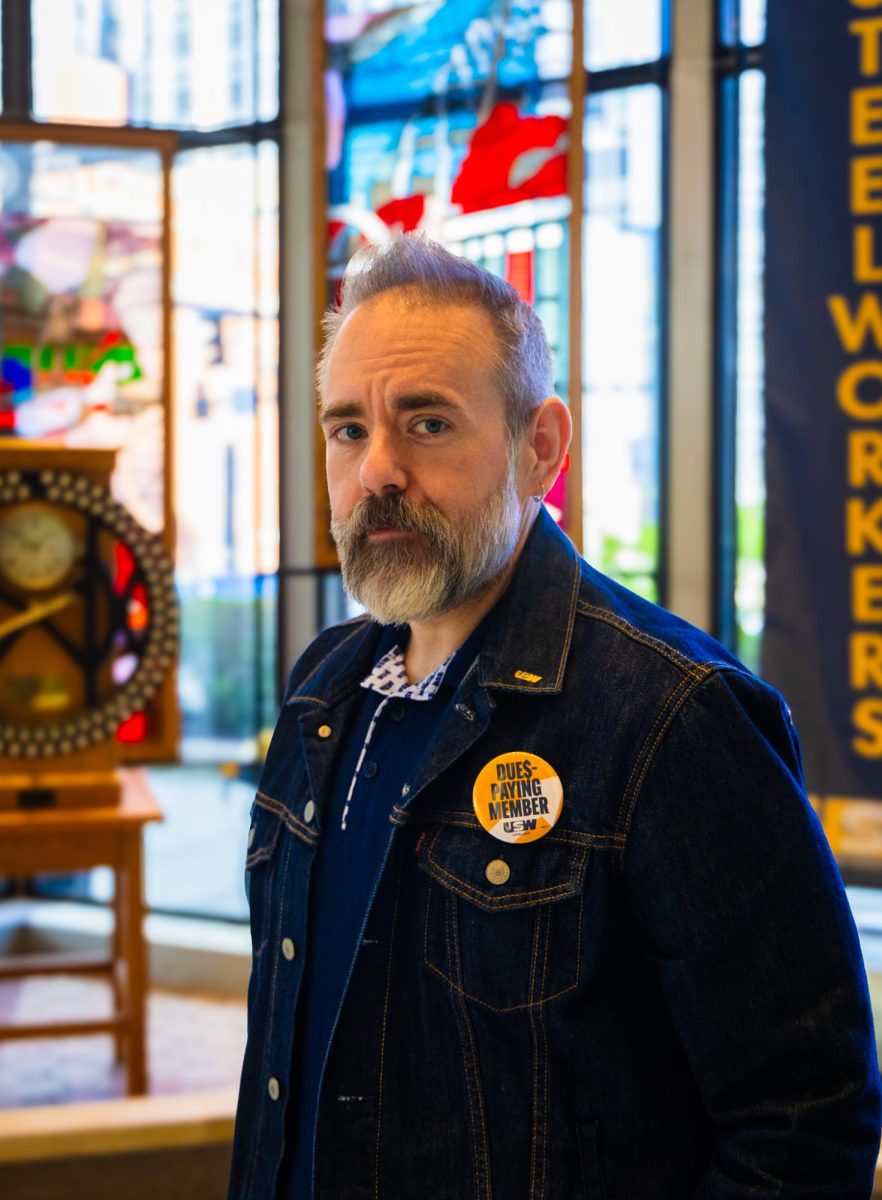
Micah Ingle estimates he makes about $3,500 teaching the only psychology class on his roster this semester.
The adjunct psychology professor is burgeoning into a career in therapy, which requires upwards of 3,000 hours of training for a license — all after decades of time spent in school earning a doctorate.
Prior to that, Ingle was at one point teaching five classes in his department; an amount which essentially made him a full-time professor, only without any insurance or other health care benefits.
Why? To get by financially, he said.
“I would never want to teach that many courses in a semester,” Ingle said. “It’s too much work, it’s too exhausting and — especially part-time — it’s not worth the pay. But, you know, I was trying to survive.”
Ingle and two other professors in psychology, who preferred to remain anonymous out of fear of retribution, have worked odd jobs in various other fields to scrounge up the funds to keep their lights on.
It’s a struggle that Richard Schiavoni, the president of Point Park’s part-time faculty union, said he’s trying to mitigate as much as possible during ongoing contract bargaining with the university.
Part-time faculty make up some majority of professors at Point Park, but no sources could verify a figure for exactly how large that majority is.
Bargaining, which began around the end of November when the union’s last contract expired, hit a bump about two weeks ago, after Schiavoni said Point Park’s negotiators offered to maintain the economic terms of the previous contract — what he calls a “0% raise.”
Schiavoni said the union’s initial offer was a cumulative pay increase of about 18%, a jump he said he hopes can bring part-time faculty’s per credit payment closer in line with that of full-time faculty’s.
Schiavoni said the lowest paid adjunct gets about $1000 per credit they teach. Conversely, the lowest paid full-time professor gets $2380; meaning adjuncts make around 42% of what full-time faculty make per credit.
“It’s an issue of dignity for us,” Schiavoni, who clarified he had no qualms with full-time faculty, said. “… in bargaining, both sides will present [terms of] the contract. Ultimately, at the end of the day [when bargaining is over], both sides agree with the contract. I may not be thrilled with everything we get at the end, because maybe we don’t get everything we want. And the other side of the table feels the same way, but it’s something that we can mutually agree on.”
Representatives of the full-time faculty union were not available for comment by press time.
The university has since, as of publication, raised their offer to a cumulative raise of around 2%, Schiavoni said.
Point Park is adamant that it respects over 500-strong part-time faculty, Lou Corsaro, the university’s assistant vice president of public relations, said.
“Point Park University is proud of its part-time faculty and the practical expertise they bring to the classroom,” Corsaro said in an emailed statement. “They play an important role in delivering our students the kind of real-world education they require to succeed upon graduation.”
Corsaro and other negotiating officials declined to comment further, and said the university “keeps negotiations at the bargaining table” as a matter of policy.
Not Schiavoni, though.
“2% is for milk,” he said. “2% is not a raise for a faculty member who is living a life raising a family, teaching their students, delivering a product at a university that relies on the work that they do.”
That’s especially true for adjuncts in COPA, according to Gerard Holt, a part-time professor in the School of Dance who also serves as the union’s treasurer.
Holt teaches morning ballet classes five days a week, and supplemental ballet classes on Tuesday and Thursday on top of that. When he’s not teaching at Point Park, Holt said he also teaches ballet at Seton Hill University.
“… I do not think in terms of balance,” Holt said. “I do what I have to do and get on with it.”
In COPA, Holt said it is especially difficult for professors — who often offer one-on-one instructional time with students — to maintain their finances while being the best professor they possibly can.
Adjuncts are only paid for the time they spend teaching class, and don’t receive any supplemental income for things like preparing lectures, structuring courses or meeting with students.
Two other professors in COPA, who wished to remain anonymous, said this was a particular pain point.
One professor said they are “absolutely” not putting the effort they’d like into teaching, entirely because they say they are not paid enough.
“I’d love to spend more time updating and changing and thinking about better ways to achieve learning outcomes,” the professor said. “But when some senior faculty have already kind of decided the route for some of the material, it’s hard to want to spend a bunch of extra time doing that for no additional money.”
Health insurance, and other related benefits are at issue, as well.
Adjuncts must work 130 hours per month for an academic year before they qualify for any benefits — Ingle in psychology said he’d have to maintain his five-course workload for an additional semester to qualify.
In COPA, another anonymous professor said the guidelines for health benefits are “impossible.”
“That’s a carrot you’re given that you can’t have — it’s perpetually on the string in front of you,” the professor said.
The issue of faculty pay, generally, is emblematic of a national trend. College enrollment is overall down over 8% from its 2010 peak, according to the Education Data Initiative, meaning there’s less tuition dollars to go around.
For private universities like Point Park, that means saving money on cheaper adjunct professors, who are increasingly charged with filling gaps in curriculum. Adjuncts make up about 46% of the workforce in private institutions nationally on average — and 37% of public institutions — according to the College and University Professional Association for Human Resources.
Some members of the union acknowledge this, and say the university — which bumped its enrollment 10% this academic year — is doing its best, all things considered.
The union generally represents a vast array of financial need; all adjuncts are automatically members upon their hiring by Point Park.
That means that everyone, from starving artists to practicing attorneys, are covered by the same contract. To Schiavoni, the “wide-cross section” of union members is no issue.
“We take this position as a union that an injury to one is an injury to all,” he said. Still, “Our concern is making sure that the most vulnerable are going to be taken care of.”
The union’s last three-year contract was ratified in March of 2023. Its then-333 members got a raise of 12% by the end of the contract, at a rate of 4% each year.
First established in 2014, with its first contract ratified two years later, the part-time faculty union has been no stranger to apparent stiffs from the university, according to Jason McCune, an adjunct in the theatre department who was the union’s first president.
“The administration viewed us then,” McCune said, “in the words of their $500-per-hour negotiator, as ‘fungible:’ replaceable and interchangeable without loss of value or function in the system.” He clarified he does not know if that is still, currently, the university’s viewpoint.
McCune echoed the struggles of the part-time professor grind, noting in particular that he at one point had three jobs to stay afloat.
That workload, McCune said, makes it hard to focus on — and improve at — teaching classes.
“Just because you do something for a paycheck does not mean you have the ability to teach it effectively to someone else,” McCune said. “It takes time to become an effective teacher, and I would think that working professionals who become good teachers should be valued more highly by the administration.”
Jason Mileto, an adjunct graphic design professor, said teaching on top of his full-time job as a video editor for Highmark is “a lot.” Mileto said he is especially discouraged by the “disjointed” aforementioned pay gap between part-time and full-time faculty.
“They’re having these students just watch YouTube videos half the time or teaching them stuff that’s outdated,” Mileto said. “It’s not a good look, and it’s not encouraging.”
Some adjuncts are discouraged by the union itself.
Chuck Berry, a part-time marketing professor, said he has been left out of many of the union’s blast emails. Others like Berry echoed that concern.
“I would like a little more communication,” Berry said.
Other professors even went as far as saying they could potentially negotiate their own, superior contract without the union; some others said they felt they’d been paid an adequate rate for their work.
Regardless of their respective viewpoints, Schiavoni said one thing remains true for all members of the part-time faculty union.
“Nobody gets into education to make money,” he said. “You get into education because of what you love to do. But you still gotta be able to get by; you still gotta be able to pay your bills.”