

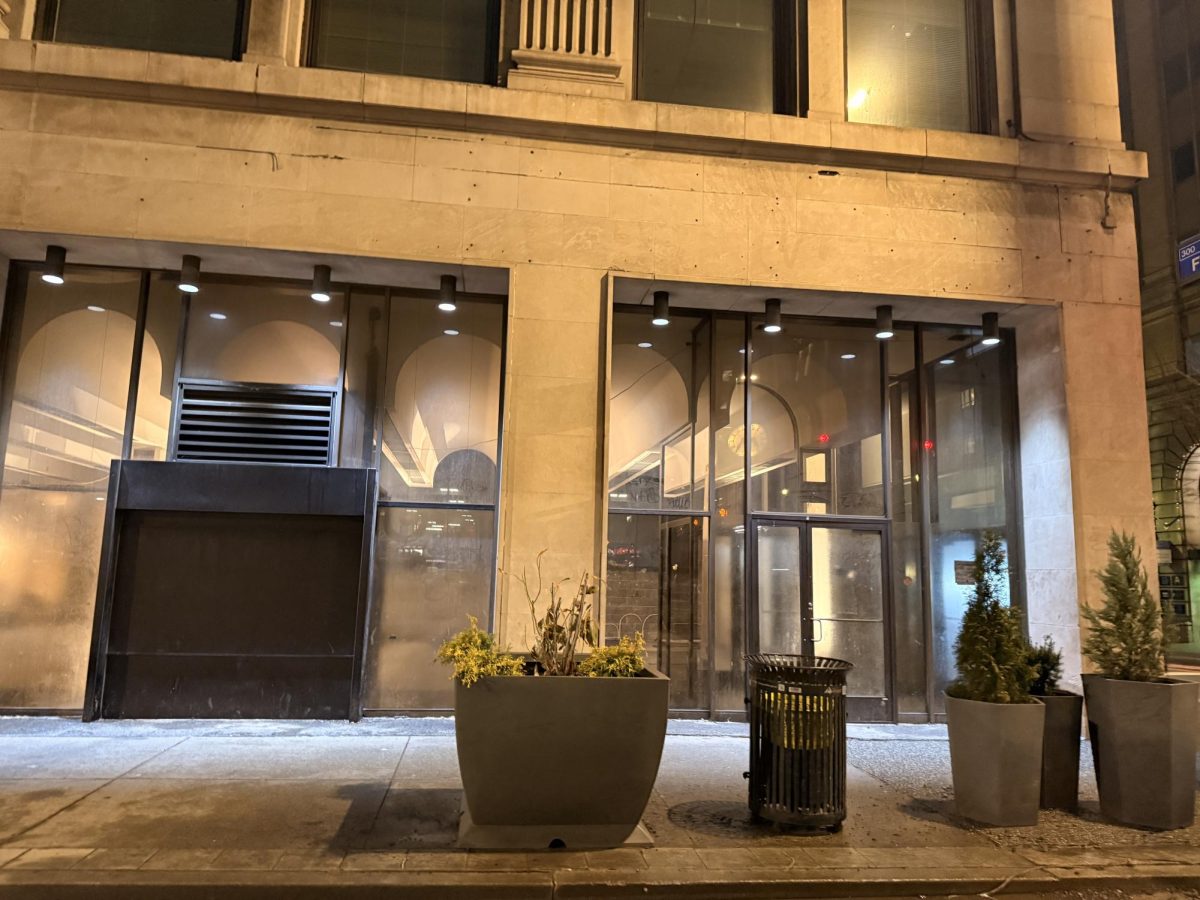
In lieu of the 2026 NFL Draft, the Pittsburgh Downtown Partnership (PDP) had a problem to take care of: empty storefronts. And the golden triangle has plenty.
According to Senior Director of Economic Development Cate Irvin, over 100 projects have been completed by the PDP, counting 53 new retail stores and art installations. About 40 of those projects are temporary public art installations on prominent streets Downtown.
And Irvin said the partnership is always trying to fill empty storefronts with new businesses or art installations to make Downtown more welcoming to all, but the draft increased the need to do so considerably. Nearly every new business opened in the span of the past year or so has rent abatement via the PDP from its “Project Pop Up” program, which lets business owners give Downtown locations a try in six to 12 month leases, with reduced rent.
Each building with an art installation features work from local artists commissioned by the PDP. And some of these buildings have been vacant for years.
For instance, the Frank & Seder building, a former department store which closed in the 1950s and was repurposed into smaller retail stores and office space until the early 2010s, tells a much different story than the old Kaufmann’s building right across the street.
At one point, both were in a similar state — effectively abandoned with little progress to show for redevelopment. But this changed in the early 2020s, especially when every retail space in the Kaufmann’s building was filled.
As for the Frank and Seder building, it hasn’t seen much redevelopment beyond the street-level retail spaces being mostly gutted, except for the last tenant, First National Bank, moving out in 2011.
And it’s not like there haven’t been any attempts to do something with the old department store. Currently, the building is owned by Cleveland-based Stark Enterprises, which floated the idea of demolishing the building and turning it into an office tower or converting the upper floors into apartments while keeping street-level areas as storefronts, albeit new and occupied ones.
However, neither plan has materialized. Stark Enterprises has tried to sell the building numerous times, with the last effort to sell it to RockCrest Holdings, a New York-based real estate firm, falling through in 2023. Jeremy Waldrup, president of the PDP, has said in interviews with other outlets that Stark needs to get moving on the project or give it up.
And beyond a few routine inspections this year, such as a check on the netting along the building’s roof coming back OK and a lack of facade inspection reports as detailed by the department of Permitting, Licenses and Inspections (PLI), little has happened beyond the installation of public art. A source close with the PDP not permitted to speak to the media said this building at an integral part of Smithfield Street and Fifth Avenue is a common frustration at the partnership.
The Frank and Seder building is hardly an exception. And some buildings that are husks of their former selves now displaying temporary art are right by campus.
333 Boulevard of the Allies, which was once a small apartment complex, an office building and a SportsClips-like salon across the street from the Boulevard Apartments and the Student Center, has seen little activity beyond a street-facing window being boarded up after one was smashed. Now, those boards have been replaced by public art, but not much else has happened.
Hanoglu Management LLC, the listed owner of the building, sued Pittsburgh Water in 2022 for a water pipe burst that flooded the elevator shaft inside 333 Boulevard of the Allies.
The last update in the case was a motion to stay in 2023, filed by Hanoglu to possibly solve the issue with Pittsburgh Water without litigation by sending engineering documents to the water company to figure out what went wrong. They originally wanted $50,000 in damages.
Beyond that, the last update to the building was a “minor alteration” permit submitted on April 30, 2024, according to the PLI.
While the art Downtown is expected to be temporary and the rent abatements on new businesses only last for six to 12 month leases, the PDP says it does not want these stores to be temporary, and hopes the businesses stay for years.