


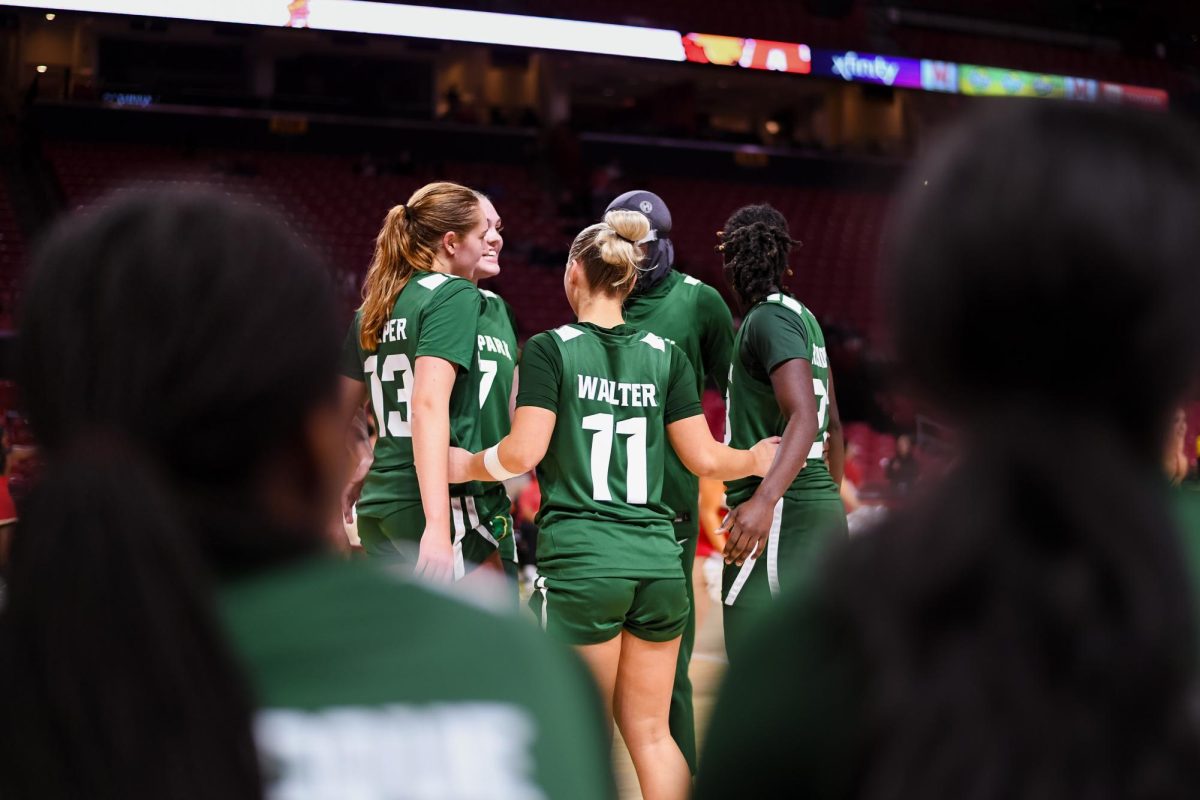
Alyssa Stridiron considered playing basketball for two or three other schools before she finally decided on Point Park.
Stridiron had driven six hours from Jersey City and booked a hotel room to tour campus, where she met with women’s head coach David Scarborough to have a look around and watch the team play at CCAC.
Stridiron, a point guard and fresh initiate into the elusive thousand-point club, said Scarborough led her to believe she had a shot at varsity playtime.
“I didn’t think I was going to have a million minutes,” she said, “but I thought I was [going to] come in and be able to play with varsity.”
And Stridiron wasn’t alone, which complicated matters when rumors of a developmental (DV) team began to circulate from other recruits.
A developmental team is akin to a junior-varsity team, where players don’t get official playtime and play smaller-scale games. They are fairly standard in collegiate sports, and are often a means of extending athletes’ eligibility to play their sport, a process called “redshirting.”
One of Stridiron’s teammates, who plays point guard but preferred to remain anonymous out of fear of retribution, decided to redshirt this season. The player said this was not a desirable choice, though, and that the coaching staff’s recruiting efforts were “feeding into [her] head.”
“They said they ‘had a lot of seniors leaving,’” she said, adding that Scarborough wasn’t involved in her recruitment.
“[That] ‘there’s a lot of playtime’ for me. They ‘didn’t have a true point guard,’ so there were a lot of minutes for me. They made it seem like it was only one team,” she said.
All three players interviewed by The Globe said they were not informed about any DV team while they were being recruited. They all said they learned about the DV team through collective rumor, and were not informed of it officially until a few days before the window to transfer closed.
“It was just going around,” the anonymous point guard said. “And I’m hearing this from other players; I hadn’t heard it from Coach [Scarborough].”
Another player, Taniyah Davis, a first-year center, went as far as transferring back to her home state of Texas to Grayson College when she heard the rumors.
Davis, who said she averaged a double-double in high school, echoed the sentiment of the other two players. Davis left on the first day of classes — the last day athletes can transfer schools — after she said Scarborough refused to meet with her to discuss the DV team.
Davis said Scarborough claimed meeting with her would violate NCAA rules, but she said her knowledge of a group chat between him and varsity players led her to believe that was a lie.
After athletes commit to a school, there is no NCAA regulation limiting their correspondence with coaches.
“I felt neglected,” Davis said, “. . . I’m coming from all the way across the country. And I can’t even talk to the coach I’m supposed to be playing for because of ‘NCAA rules,’ which is a lie.
“So now you’re constantly lying to me. I feel scammed, [and] I don’t even feel comfortable staying here.”
In an emailed statement to The Globe, Scarborough said DV teams are standard in the athletic department’s policy.
“In our program, playing time is never guaranteed — it’s earned,” Scarborough said of the women’s basketball team. “Our priority is to field the most competitive team possible, and athletes who embrace that challenge and commit to competing every day typically experience meaningful growth and success within our program.”
Scarborough added that his recruiting selects for “student-athletes who demonstrate commitment, coachability, academic responsibility and a strong competitive drive.”
He provided no further comment, and a spokesperson for the athletics department said no other women’s basketball coaches were available for comment.
After the transfer deadline passed, the DV team had a scrimmage against current varsity players. DV lost, and both Stridiron and her teammate who spoke with The Globe said that Scarborough called for a meeting.
The point guard said Scarborough “flaked.” She said he blamed university administration for the DV mix-up and claimed he had no idea there would be a DV team at all, contradicting his official statement that the developmental team is standard policy.
“It wasn’t even a meeting; it was just a huddle,” the player said, “so it kind of [felt] like he wasn’t taking the situation seriously. Why aren’t we sitting down and having a meeting somewhere?”
Keith Paylo, Point Park’s vice president of student affairs, said DV teams have been standard at the university, at least in men and women’s basketball, for a long time.
Paylo added that he thinks DV teams offer athletes a good chance at upping their game.
“You’ve got an opportunity there where you can engage [players] that might not be ready yet,” Paylo said, “but yet you could still get them a lot of good opportunities.”
Scott Swain, vice president of athletics, echoed that DV teams have been a longstanding arrangement at Point Park.
“We’ve had a developmental team,” Swain said. “We will have a developmental team. It wasn’t ever in question.”
Stridiron said since the meeting, she just plays for the sake of playing. Stridiron said she plans on making an effort to earn a spot on the varsity team, but aims on transferring if she doesn’t do so by next year.
“I’m giving them the benefit of the doubt because I’m a freshman,” Stridiron said.
Davis said she was happy with her decision to transfer. She added that her coach at Grayson claimed that Point Park coaches got a cut of the tuition of each athlete recruited.
An anonymous source familiar with the matter also said that was the case, but university administrators and officials in the athletics department have vehemently denied those rumors.
NCAA regulation forbids any sort of commission arrangement between universities and their coaching staff, and recruiting finder’s fees at universities are illegal under federal law.
“We don’t have any financial incentives for our coaches,” Swain said. “[Recruitment is] just an expectation of their job.”
President Chris Brussalis seconded Swain, denying any sort of underlying compensation structure for recruiting with any university faculty or staff, even beyond athletics.
But Brussalis didn’t rule out offering coaches pay raises for good recruitment and said he believes in “meritocracy.” Coaches are paid wages and stipends benchmarked by a “national firm,” he added.
“If someone’s a superstar and they perform, we want to keep them,” Brussalis said. “They’re going to be compensated well in a marketplace . . . but we don’t give commissions.”
Athletic recruiting generally has driven boosts in enrollment since Brussalis enshrined that effort in his strategic vision, Pioneer Vision 2030, last year.
This academic year’s freshman class was the largest in recent memory, with about 10% more students enrolled this fall than last.
And officials have touted athletics as a key driver of that. An early September press release said this year’s class of athletes was the largest on campus and that the program is seeing “historic growth.”
Swain isn’t shy about the university’s sports programs being an “enrollment driver” for Point Park.
He said athletes can get anywhere from $1,000 to $5,000 in scholarship aid just from athletics, and that there are not many instances of student-athletes receiving full-tuition scholarships.
Davis and the other point guard said they paid — or would have paid — around $15,000 annually in tuition; Stridiron was closer to $25,000.
Neither of those estimates include contributions from FAFSA, which would be paid to the school on top of each student athlete’s own tuition payment.
Coaches do not factor in how much potential student athletes might pay in tuition, though, according to men’s baseball head coach Loren Torres.
“At this level, there are no incentives like that,” Torres said, echoing that neither he, nor his assistant coaches, are paid any sort of commission for recruiting. “There’s no image and likeness. There’s no big contractors . . . It’s [more] like a professor or a staff member.”
Coaches do have a recruiting quota, but Torres said it is based on how many seniors on the team graduate. He clarified that there is no financial incentive — for either the coaches or the baseball program at large — to hit that quota.
Torres and his coaching staff recruit both nationally and internationally, with contacts as far away as South America and, domestically, as far west as California. Still, Torres estimated that over a third of his players hail from western Pennsylvania.
“We really cast a wide net; turn every stone and make sure that when the bell rings, we have the substance.”
That strategy seems to be working, as the men’s baseball team went all the way to win the MEC conference championship last season.
Torres is a full-time staff member, while most of his assistant coaches are paid “small” stipends for their efforts. Torres commended his assistant coaches, adding that many of them only coach on the side and have full-time jobs outside of their work for Point Park.
Torres said while recruiting, coaches don’t usually strongly consider a player’s stats, and getting a student athlete onto the varsity team is a universal goal.
“We’ll give [them] an opportunity to come try,” he said, “and we won’t cut anyone.”
Swain echoed this sentiment, and said athletes are recruited based on their ability to play their sport.
“We’re recruiting athletes to boost enrollment,” Swain said. “You can’t recruit all superstars.
“You recruit a fair number of athletes to it. And also you’re recruiting athletes that are — let’s be blunt — willing to come to Point Park.”
Many players that end up on DV, like Jalen Dunn, are dedicated enough to give the varsity jump a shot.
Dunn, a graduate student and guard, has played for the men’s DV basketball team since he first arrived at Point Park in the fall 2020 season.
Determined to play basketball at the collegiate level, Dunn said he “cried like a baby” when he was invited to play for the men’s basketball team on a scholarship. He added that coaches were clear he’d be on the DV squad.
“I was truly blessed,” Dunn said, “because coming out of high school, Point Park gave me the best chances — academically and athletically.”
His never-give-up attitude has driven him to continue to strive to get moved up on the team.
Despite COVID shutdowns, a torn ACL, and playing under three different coaches, Dunn said he still hopes to have a shot at varsity.
“Basketball’s a game of runs,” Dunn said. “You gotta be ready for what life throws at you.”




Camie • Dec 5, 2025 at 4:29 PM
Scarborough is a horrible excuse for a coach he is just a LIAR that should be FIRED and never be able to Coach or Recruit again!! For almost a year, Coach Scarborough & Coach Carr were calling these girls every week building trust, promising opportunities, telling them how they were going to “help him win games,” making them feel wanted. He is also known to invite girls to his home for dinner during recruiting. With all that contact, all that relationship building, not once did either coach mention a developmental or secondary team!!
And here’s the part that really exposes what was going on:
My daughter flat-out asked about a development or JV team because She heard some colleges/universities have them so she asked directly whether that would be something she needed to worry about.
And they told her NO! she did not have to worry about playing for a development team because they “recruited HER for a reason.” They also said they weren’t having a development team which was a Flat out LIE!
My daughter told them to their faces:
“I want to go somewhere I’m wanted and where I’m going to play. I don’t expect to start I just want to play.”
And he said:
“I definitely want you here to play for me.”
Yet once she committed suddenly communication was almost nonexistent she and multiple recruits were told they were being placed on a “development team” two weeks after classes started, and according to the article, this was deliberately kept quiet from recruits until it was too late to transfer.
That is not a miscommunication.
That is lying to kids and families.
Calling teen girls for months, promising them a role on your varsity team, telling them they’re part of your game plan and then assigning them to a hidden team you told them didn’t exist for them is manipulative and unethical!
Our daughter didn’t stay silent. She went to bat for herself and filed reports with Title IX, the Dean, and the NCAA. She demanded to leave Point Park immediately and finish her courses online. She had a meeting with the Dean and he allowed her to finish classes remotely because he knew she was wronged and even told her that directly and apologized for what happened to her and said the Coaches were currently being investigated. I’m very curious to know what consequences these coaches faced for playing with these young ladies futures because even though my daughter is passing all her classes with flying colors and joining a new team after exams Coach Scarbough and Carr robbed her of her first ever college experience it will always be this nightmare…
Andrea B. • Dec 5, 2025 at 1:53 PM
You want the long, long version or the short. I’ll start here for now. If he (Dave Scarborough) hadn’t been recruited, then PPU would never have been an option. We had never heard of this university until he reached out. My family was also lied to about playing for the varsity team. The coach (Dave Scarborough) never mentioned a “DV” team. My daughter had offers to play sports at other colleges. He wasn’t honest in anything he stated. He offered scholarships, but stated, “You’ll have to wait until spring to receive the scholarship because the school was just receiving NCAA recognition. There are so many parents with the same storyline you can make an album and remix the lies he’s told. It’s like he had a “playbook” full of deceit to get students to enroll there. Many athletes didn’t have the privilege to excel in two sports like my daughter, so now you have young girls on the verge of becoming young women who are distraught and heartbroken because he lied. My daughter tried playing on the JV team, but the assistant coach was so rude and nasty that the foul language and disrespect were beyond comprehension. The administrators appear to have found a way to smooth it over as if the JV team had always been a part of the athletic team. If that were true, it would have been stated regardless of the outcome…because it’s a part of their policy. My daughter is an A student-athlete, so of course, that looks great and opportunistic for the university. She plays another sport, which is a blessing in disguise, and her coach has been phenomenal towards her and my family. He is a great mentor, teacher in guiding her to strengthen and amplify her athletic abilities. This post is for the young ladies coming behind my child, thinking they’re about to see their dreams come true, only to wake up to a nightmare.
Marlon McCoy • Dec 4, 2025 at 9:20 AM
Yea my daughter also was informed she’s play she had plenty of scholarships I basically kinda pushed for point park just for this is a crime I’ve never heard of a college Jv team all these girls where lied too during recruitment I feel like they should all transfer an go where they can play!!! An the coaches should b reprimanded for lying to the girls an us family members
Dwayne Hamilton • Dec 3, 2025 at 1:25 PM
The issue with the women’s program is the HC did not speak with any of those he “recruited” about a DV team. I am sure if he had several of those who transferred would have made the decision to go elsewhere that provided offers, than spend thousands unnecessarily. Some may have even accepted. The creation of a loss of respect for the coach and lackluster attitude towards addressing ALL players will lead to a larger decline than growth; as well as, limit the success of not only the program, but also the young ladies involved.