


The NFL Draft has everyone in Pittsburgh scrambling.
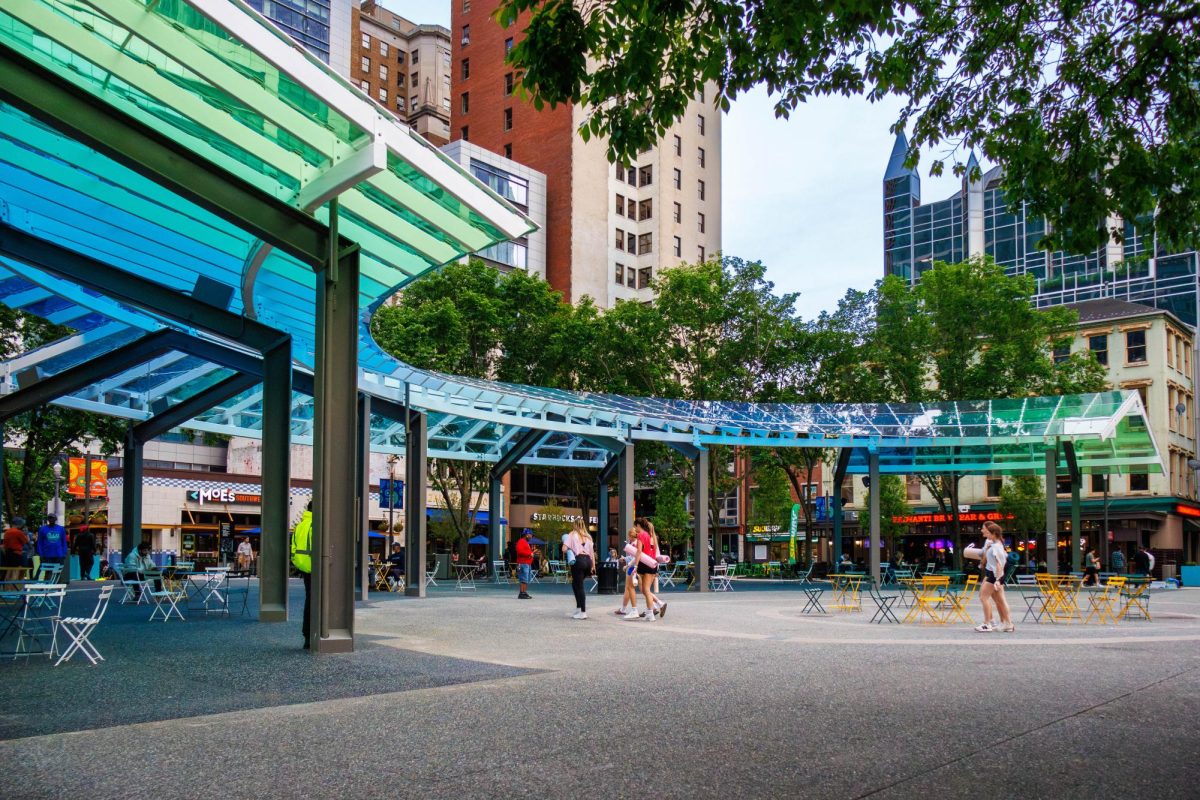
From the year-long effort by the Pittsburgh Downtown Partnership (PDP) to both refurbish Market Square and build an entirely new “Arts Landing” near the Three Sisters bridges, to Mayor Corey O’Connor’s effort to beautify Downtown through public works projects, just about everyone in any position of power is in overdrive getting the Golden Triangle ready.
Erin O’Neill, the curator director of the recently opened Benedum-Trees Gallery, is in the same boat.
In about a month, he and Richard Kelly, an adjunct photography professor at Point Park, co-curated a new exhibition in the gallery, “The Confluence Stronger than Steel,” which held a soft opening last Thursday.
It’s part of O’Neill’s ongoing effort, beyond the Draft, to bring more art into what he calls the “East Side” of Downtown. And so far, O’Neill said, he’s optimistic in that effort.
“I think we’re going to piggyback and leverage and springboard off from all of the Draft energy, money, and investment that is coming into this part of town with the Market Square [revitalization],” O’Neill said.
The exhibition is primarily focused on the industrial history of Pittsburgh, which both O’Neill and Kelly said they felt was a point missing from other Draft events.
It’s open on Thursday and Friday from 4 to 7 p.m. and Saturday from 10 a.m. to 4 p.m.
“The Confluence Stronger than Steel” is partly centered on Joe Magaroc, an early 20th century John Henry-esc figure of local steelworkers’ mythos. To Kelly, Magaroc echoes the energy of the Pittsburgh Steelers.
“I sort of felt like there is something to this mythology of the strength of steel and…it’s connectedness to the sports that we’ve come to love,” Kelly said.
There’s also a variety of pieces from Patterns of Meaning, a collective of artists that create pieces from old industrial scraps to honor the efforts of the past. Their team — Cory Bonnet, A.J. Collins, Brian Engel, Nate Lucas and Mia Tarducci — supplied a variety of works.
Old steel molds from about the late 1800s are a prominent feature. Patterns of Meaning showcase the molds themselves, along with their blueprints, but have made their own tasteful additions.
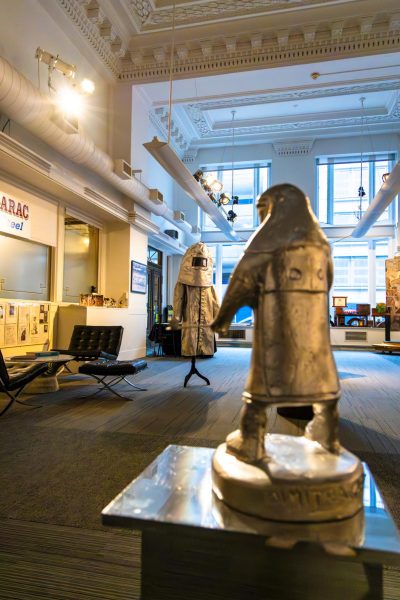
Other pieces showcase steelworkers looking onto scenes of fire and melting steel, or working in equipment of the time.
Rivers of Steel, who create art and hold workshops and seminars on Pittsburgh’s industrial history out of the Carrie Blast Furnaces in Rankin, also contributed.
Kelly said he and O’Neill spent time digging through Rivers of Steel’s basement archives to find pieces suited to their vision of celebrating Pittsburgh’s industrial history.
All this, along with some vintage pieces of Steelers memorabilia — and a recreation of Art Rooney Sr.’s office door — aims to merge Pittsburgh’s renowned industrial history with its equally well-known history in sports.
Mark Houser, a former investigative reporter for the Tribune-Review and history author, previously collaborated with O’Neill on past exhibitions. He agreed with O’Neill and Kelly’s vision to highlight the history of Pittsburgh in the gallery.
“I think that, certainly, learning and appreciating our history is one of the best ways to create an understanding, intelligent and caring society,” Houser said. “We can learn from the mistakes of the past and the successes of the past alike.”
Kelly said he found it difficult, at first, to put together an exhibition catered toward Draft-goers. But the Steelers, being local participants in the Draft, were a good jumping-off point.
“We started to think about if someone were coming to Pittsburgh, and they didn’t know a lot about us,” Kelly said, “they probably know that the Steelers’ name comes from the steel industry.
“And there’s a long history of connectedness between athletics and industry in this town. So, why don’t we dig into that a little bit more?”
The time constraint of only around a month to get the gallery together was a challenge for both of the curators, they said.
If it weren’t for such a limited amount of time, Kelly said he would have liked to have more participation from Point Park students.
“The timeline just didn’t match up,” Kelly said, adding that both he and O’Neill tried to get both student and alumni work ready in time for the exhibition to no avail.
Kelly added, though, that because Point Park doesn’t have much gallery space on campus, the Benedum-Trees gallery could be a good future avenue to show student works.
“I think we’re now starting to think, okay, how can we work with this institution, this gallery space and make some things happen,” Kelly said.
O’Neill worked with Point Park in the past on the recent “Pencil to Performance” exhibit, which showcased 10 Playhouse productions.
Everything that went into the shows, from beginning sketches to some finished props, was showcased in the gallery.
O’Neill called the exhibition, which he estimated garnered around 300 visitors and ran from November to February, “successful” — the gallery, he said, is “still getting on the radar.”
“We wanted to highlight the unseen powerhouse that Point Park has and bring it to the public in a way that is revealing,” O’Neill said.
O’Neill said he has lavish plans for the future of art in Point Park’s side of Downtown. He said both Point Park itself, and its student body, should contribute to opening another gallery.
Art, O’Neill argued, is crucial to the core of Pittsburgh.
“I think it’s really important to have an active, appreciated Downtown,” O’Neill said, “I think if you don’t have it, the other parts of the city start falling off.”